Understanding Trex Decking: A Comprehensive Guide
Home ownership comes with a seemingly endless list of maintenance tasks. Any new home improvement product or genius DIY tip that solves a problem while also limiting the ongoing investment of time and money tends to generate a lot of buzz—particularly when it delivers on its promises. That’s why Trex, a virtually maintenance-free composite decking brand, became hugely popular the instant it hit the market back in 1996.
Curious if composite decking is still in style today? Definitely, according to the pros. “Composite decking has gained popularity, and modern product lines offer stylish colors and textures that complement today’s home design trends,” says Reuben Saltzman, a second-generation home inspector and the CEO of Structure Tech Home Inspections. “It’s a solid long-term option for homeowners who want durability without the ongoing maintenance.”
It’s safe to say Trex decking is still getting people talking, whether online or around the neighborhood. If you’re wondering if it truly lives up to all the enthusiasm, consider this your ultimate guide to understanding the product’s composition, installation, and affordability, plus how it compares to wood in terms of look and feel, so you can decide if it’s right for your home.
What Is Trex Decking?
The core product for Trex Company is a wood fiber-polymer composite material, which it forms into nonstructural (surface) components for building a deck. Trex started as decking, but now manufactures a complete system for deck construction and incorporates its low-maintenance composite into a wide variety of products that complement and extend the versatility of outdoor living spaces.
Composite material never requires refinishing, does not rot, splinter or twist as it ages, and it resists insect damage. Trex decking also boasts a durable shell that covers its composite core, which resists wear, fading and the growth of mold and mildew, while improving the cosmetic quality of the wood grain and further reducing maintenance to a simple cleaning process.
Best of all, the manufacturing process of the Trex composite consumes 95% recycled materials. At one point, the company claimed that it was consuming as much as half of all available recycled plastic film in the United States. In the period between 2007 and 2012, the company kept more than 2.5 billion pounds of plastic and wood scrap out of landfills. A typical 500-square-foot deck contains 140,000 recycled plastic bags.
The History of Trex Decking
Chemist and entrepreneur, Roger Wittenberg, has made a career of transforming waste streams into revenue streams. During the 1980s, his enterprise manufacturing chicken feed from bakery leftovers led to the sale of breadcrumbs made from waste loaves. Although the breadcrumb biz was a money-maker, it did have its challenges. Using cheap, excess bread for his raw material left him with thousands of empty plastic bread bags each day. Solving the challenge of that waste stream eventually led to Trex.
By 1988, Wittenberg had found a way to bind a composite made from two waste products: plastic film (largely grocery bags collected for recycling) and wood scrap, such as sawdust and tailings from furniture manufacturing. In 1992, Mobil Oil bought the technology. Later, the Exxon/Mobil merger led to divestment of the company’s plastics division, but not before it identified decking as the target market for Wittenberg’s composite wood substitute. In 1996, Wittenberg and a team of investors acquired Trex and the current company was born.
Best Uses for Trex Decking
Because the composite material at the core of Trex products does not stand up to structural loads, its best use is for surface applications, the most obvious being deck surfaces. Product development has focused on improving cosmetic performance with more realistic wood grain, the ability to take more abuse from foot traffic and better protection from sun exposure and spill stains.
However, Trex can be made into benches, planters, yard games, outdoor furniture, shelves, and more based on your imagination. Just keep in mind that its design carries a body-weight load across the span of 12 to 16 inches, and a typical deck is designed to support 40 pounds per square foot.
Top Pros & Cons of Trex Decking
No matter how you choose to use it, lifespan and consistency are the biggest wins for any composite decking option, Saltzman says. Here’s a snapshot of more pros and cons of Trex decking:
Pros of Trex Decking:
- Very low-maintenance.
- Requires no sanding, staining, or sealing, and only occasional cleaning.
- Durable. Stands up well to heavy traffic and can easily last decades without rotting, splintering, or warping.
- Aesthetically versatile. There are plenty of wood grain patterns and color choices available, plus deck board appearance stays consistent.
Cons of Trex Decking:
- Expensive. Costs add up when it comes to composite, from boards to installation which is recommended.
- Retains heat. Composite gets very hot when the sun hits it (especially dark colors and dense boards).
- Slippery when wet. Depending on the grain you select, composite can be more slippery than wood when wet.
Is Trex Decking for DIYers?
Although the recommended installation of Trex uses a proprietary hidden fastener system, the product is DIY-friendly and the company offers resources that walk you through the process from estimating, design and ordering to site preparation and installation. The company’s website offers a series of video tutorials and downloadable PDF files that illustrate every aspect of construction.
“If you’re going to replace wood deck boards with composite, just be sure to read the manufacturer’s instructions carefully, as composite decking will often need more support than wood boards, especially on stairways,” Saltzman advises.
How Much Does Trex Decking Cost?
Comparing the cost of Trex to wood, the Trex Enhance Basics line is designed to compete with the cost of pressure-treated wood decking and scales up from there. Trex notes, however, that the higher initial investment at installation eliminates the cost and effort required to keep up a wood deck on an annual basis. In the long run, a Trex deck has the potential to save you money.
Where Can You Buy Trex Decking?
Find a limited selection of Trex decking off-the-shelf at The Home Depot and Lowe’s. Special ordering offers a wider selection. To access the full Trex product line, contact a local lumber yard (the Trex site has a dealer locator).
FAQs
How does composite decking compare to wood?
In general, wood, including cedar or pressure-treated lumber, is less expensive and gives a more natural appearance, but it needs regular maintenance, Saltzman explains. “Composite costs more initially but pays off in the long run with less upkeep,” Saltzman says. “After I refinished a wood deck for the first time, I decided I would never use wood deck boards again.”
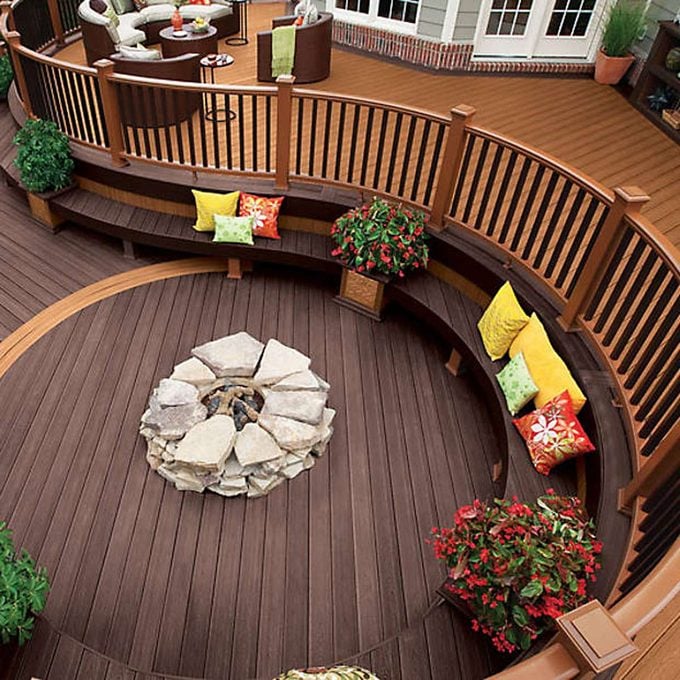
Trex composite decking, in particular, also does some things that wood can’t. Trex fasteners go in between deck boards, keeping the walking surface smooth and unblemished. Do you like curves? Trex Customcurve allows deck designs to incorporate dramatic, sweeping arcs and wraparounds.
Is composite decking slippery when wet?
“It depends on the brand and the texture,” Saltzman says. “Some older or cheaper composites can be slick, especially when wet. Newer products often have textured surfaces designed to reduce slip risk.”
Expert
Reuben Saltzman is a second-generation home inspector and the CEO of Structure Tech Home Inspections in Maple Grove, Minnesota. He is also a Director for The Examination Board of Professional Home Inspectors (EBPHI) and teaches home inspector seminars across the U.S.