Embracing the Mess: A New Perspective on Productivity and Order
I’m writing this piece from bed because my desk is buried under stacks of books, along with unopened post, a pile of washing (clean) and a clutch of dirty mugs. It’s not exactly an ideal workspace, but I’ve found that being surrounded by clutter hasn’t stopped me from being more productive than ever before. In fact, I’ve completed more work each month, managed to get piles of clothes to the charity shop or on Vinted, and even done my dreaded but vital cull of books.
This isn’t like me. I love order and hate trying to work in a messy office. As I share my workspace with the boiler cupboard, getting clothes washed and put away – not left hanging around on radiators – is a daily trial and quite possibly my life’s work. But while stuck in the limbo zone, I managed the impossible. I got straight to the point.
The real value hasn’t come through working or organising stuff. What has stuck out are the times I’ve spent with my daughter watching telly or drawing, or the liberty I’ve given myself to read magazines; all things I previously would put off, prioritising the boring stuff. Or worse, I might have agreed to family or social stuff but found myself unable to enjoy it, too busy worrying about the stack of housework waiting for me at home.
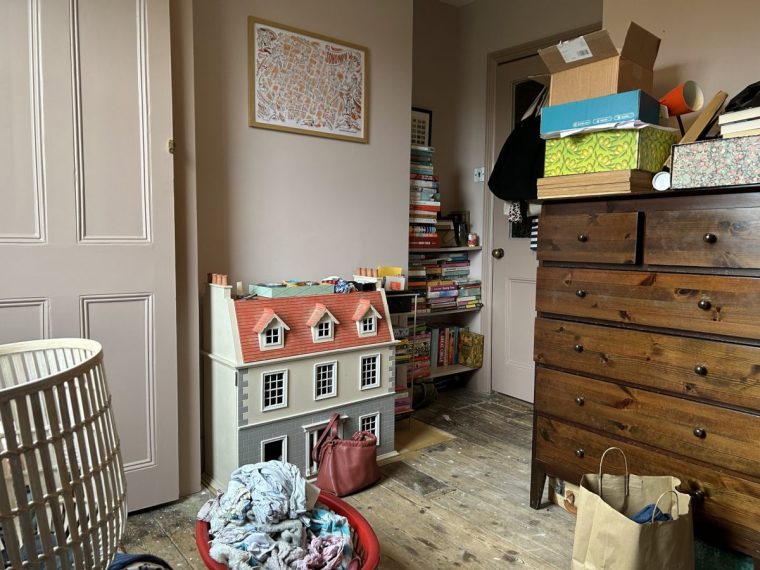
Is cleanliness really next to godliness? Does a tidy room genuinely lead to a tidy mind? I’ve always been someone who tries to organise a space before I feel ready to work in it. But as hard as I try, this approach usually leads to failure: there is always something new to declutter, reorganise or clean.
My growing suspicion that my life might not be better if it were tidier didn’t start with my current mess. Last year, I read with interest the part of Meditations for Mortals by Oliver Burkeman, which instructs readers not to bother tidying up for visitors – so-called “scruffy hospitality” – which posits that inviting people into your home as it is will deepen your connection with them, allowing them to see you as you are. Even better: you can lie around reading the papers until they arrive.
Burkeman discusses “the fantasy of getting on top of things,” and he’s right. Getting on top of things is a much-loved colloquialism but a total fallacy. And what would you do, anyway, if you found yourself to be completely on top of everything in your personal and professional lives – get ready to die?
“We go through life feeling like, ‘Just after I’ve got this next thing out of the way, I’ll do something nice’,” writes Burkeman. “That constant process of living a few hours into the future, mentally, comes at the expense of never feeling fully alive in the moment.”
Now that the decorating is over, I keep meaning to tidy my desk, to return the books to the shelves in my bedroom and to sort through my post. In fact, I confess that writing this piece has spurred me on to a little light rearrangement. But overall I’ve prioritised work or family-time.
Read Next: The only four supplements that actually make a difference, according to the experts
Maybe I have finally realised that there’s no such thing as “done” or “ready”. Two friends who I consider great “doers” – I hesitate to use the word “productive” but they are both professionally very successful – do not limit themselves with the empty details of order. They just get the work done.
Alex Iga Golabek, psychotherapist and founder of Ego Therapy, points out that one person’s tidy desk, holding little but a few meaningful objects, might not work for others, who could find the same set up leading to overwhelm, lower productivity or anxiety.
“The notion of tidiness can mean very different things to everyone,” she says. “Work spaces are also intimate spaces so our focus can be guided by how we are represented by them. The idea of belonging to a space is so important to our wellbeing and can often inform the quality and pace of the work we carry out, as well as our internal state.”
Golabek kindly points out that my tendency to retreat into small practical and administrative tasks isn’t entirely without merit. “When we experience overwhelm, it may be useful to tick a few things off the list to regain a sense of balance and safety, to help us engage fully,” she says. “I am not surprised that you’d choose to tidy your space in the first instance – it can help you gain an impression of autonomy and strength, to feel a sense of accomplishment before we undertake a bigger challenge.”
Phew. How did we become so obsessed with decluttering culture? Marie Kondo’s The Life-Changing Magic of Tidying Up was first published in English in 2014 and her Netflix show came out in 2019. Surely the roots of our complex relationships with order and mess stretch far further back?
“There are a few social paradigms linked to the value of tidiness within the Western culture,” says Golabek. “Our social standing and a sense of competency have been traditionally linked to maintaining a neat appearance. There is a perhaps slightly outdated idea that if we present this way, this must be a consequence of being well adjusted, in control and successful.”
There’s definitely a fair amount of evidence to suggest that organised spaces can aid organised minds, as well as the inverse: that messy houses can be stressful. A University of California study found that mothers who feel their homes are cluttered have higher cortisol; another study linked cluttered bedrooms with sleep problems; a study from Syracuse and Cornell Universities reported that messy kitchens can lead to more, and less healthy, snacking.
I haven’t gone over to the dark side. I don’t associate a bit of mess, and the ability to overlook it when there are other priorities, with a celebration of hoarding, and I am firmly in favour of cleaning. I stand by a piece I previously wrote about the Swedish practice of döstädning, known in English as death cleaning, which means to clear out and prepare your home for one’s own death, rather than leaving a right royal mess for whoever’s left. But we seem to have reached a place where order and cleanliness are valued as if they mean something critical about your character.
As soon as IKEA began selling its dream of simple – and eternally replaceable – decor, we all rushed like lemmings towards the mythic idyll of grey and white and pine and plastic and ennui. I am fully in favour of streamlined interiors, but prefer buying less and having less rather than constantly junking and purchasing new.
“A perfectly kept house is a sign of a misspent life,” claimed Mary Randolph Carter, an author and former Ralph Lauren creative director, famous for defending the virtue of homely clutter. Our UK counterpart is writer India Knight, whose new book, Home, along with her newsletter of the same name, extols her very popular vision of a house that is full of life, character, beauty and busyness, railing against “Marie Kondo mania” and the “ghastly visual uniformity” of IKEA. She is lucky to have an exceptionally beautiful house, and a great many gorgeous things to display in it, but insists we will all feel full of “blissful ease” if we show off and celebrate our stuff instead of throwing or hiding it.
While being productive can be satisfying, my goal has never been to free up more time only to fill it with more work. Golabek points out that acceptance, in and of itself, can be worthwhile. “There is great significance in acceptance,” she says. “It sounds like you’ve allowed yourself to reach beyond the expectation you’ve been carrying and instead, to become curious about a new approach – and it’s worked!”
Only time – and my office-in-the-airing-cupboard situation – will tell.